
A weekly golf league is the best thing in a lot of people's week, and the worst thing in the commissioner's. Here is how to set one up so it runs for years, and what the person keeping the book actually does every week. Golf Mafia was built to replace one such league's spreadsheet, so the end of this guide shows how the app does each step.
Decide the shape of the league before the first tee
Most leagues that fall apart never decided these five things out loud. Decide them once, write them down, and the arguments stop before they start.
- How many players, and in what teams. Twelve is the sweet spot for a weekday league: two teams of six make three foursomes, and two or three substitutes a side cover holidays and bad backs. Two fixed teams for the whole season give every round a rivalry that a loose "whoever shows up" league never has.
- Which days, and what tee time. A league that plays Tuesdays and Thursdays at 8:30 needs nobody to ask. Pick the days once; move a round only when the weather makes you.
- A format every score counts in. In a small league, a format that throws scores away loses players. A Best-4 net match (each team adds its four lowest net scores) plus team skins hole by hole keeps every player in the match to the last green, and a blow-up hole costs a skin, not the season.
- The stakes, and when a bet is void. Five dollars a player on the net match and two dollars a skin is plenty. Agree the minimum number of players a team needs for the bets to stand (four is usual), and what happens below it (nobody pays; the scores still count).
- Who keeps the book. One person. The commissioner schedules the rounds, sets the lineup, closes the round and settles it. A league with two keepers has two sets of standings.
Set the handicaps, then keep them honest
A league handicap is not an official index. It is a number the league agrees on so a 14 and a 4 can play the same bet. Most small leagues use a rolling average of recent scores over par, or the official index where everyone has one. Whatever the method, write down every change with its date and the handicap each player used in each round, because a disputed handicap is the one argument a league cannot settle from memory. More in golf league handicaps.
Rule of thumb
Decide the void rule and the sub rule before the first round, not on the first short Tuesday. The two conversations a league never wants to have on the first tee are "does this count?" and "does he count?".
The commissioner's week
This is the list that lives in a spreadsheet and a text thread. Every item is small; together they are why commissioners quit after two seasons.
- Schedule the round. Date, tee time, course, and a word to the league ("front nine is cart path only").
- Collect "are you in?" from every player, then chase the ones who have not answered.
- Fill in subs from the standing list, with a handicap for each.
- Build the groups. Three or four to a group, teams mixed so the skins are honest, tee times eight to ten minutes apart.
- Get the scores in. Every card, every hole, the same day, before someone loses theirs.
- Settle both bets and tell everyone who pays whom, before the parking lot empties.
- Update the standings: averages, skins, birdies, money, and a note of anything remarkable.
- At the end of the season, hand out the awards and start next year's sheet.
Steps 5 to 7 are the Tuesday night. They are also the steps a phone can do while the round is still on the course.
How Golf Mafia runs the league
The app follows the same list, with the typing taken out of it.
- Create the league in a few questions: its name, the days, the tee time and the stakes, then the course, the two teams and the roster. A practice round on the way shows how scoring works. Nothing is saved until you tap "Create league" and sign in with Apple.
- Invite everyone with a six-character code, a link or a QR code on your screen. Each player installs the app, signs in with Apple, and picks their own name from the roster. Players never pay.
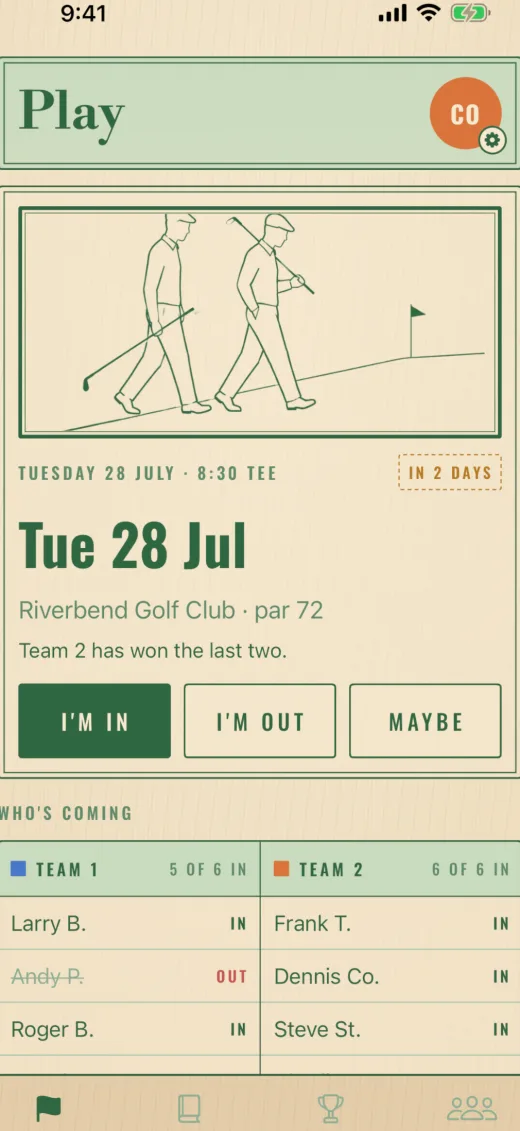
- Schedule a round in five steps: date and course, lineup, groups, formats, review. "Schedule round" sends "Round scheduled · Tue 28 Jul, 8:30 — are you in?" to every phone, with your note.
- Everyone answers in the app: I'm in, I'm out or Maybe. The scheduled card shows who's coming by team, "5 of 6 in", and substitutes take the open spots in the lineup. Two hours before the tee time, a reminder.
- Scores go in as you play, from whichever phone in the group is nearest, one tap for par. No signal? They sync later. The match board shows both teams' Best-4 and the skins hole by hole.
- Close the round and both bets are settled and frozen: who won, by how much, who pays whom. Everyone gets the result and their own standing in a notification.
- The standings keep themselves: average net, skins, birdies, the hardest holes, the money round by round, records across every season.
- End the season and the app hands out seven awards, with a card for the group chat.
How many players do you need?
For the two bets to stand, each team needs at least four players with a full eighteen holes, so eight is the floor and twelve is comfortable. Golf Mafia is built around two teams of six, with three substitute spots a side, and the minimum players for a bet is one of the league's settings. When a team is short of four, the round is void (nobody pays, the scores count), unless the league sets its minimum lower, in which case both teams add only as many best nets as the shorter team has.
What a league that lasts looks like
The leagues that run for twenty years share three habits: the same days every week, a format in which nobody's round is wasted, and a book everyone can see. The first is yours to keep. The second is the Best-4 format. The third used to be a spreadsheet one person could open; now it is an app on every phone.